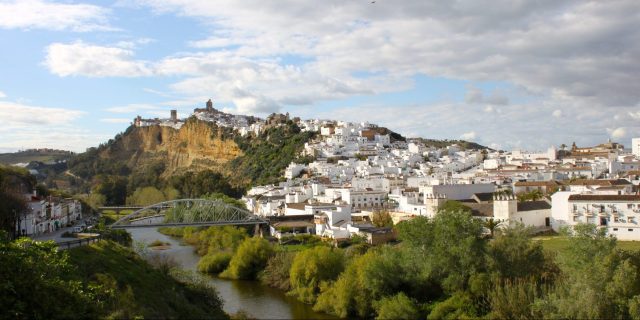
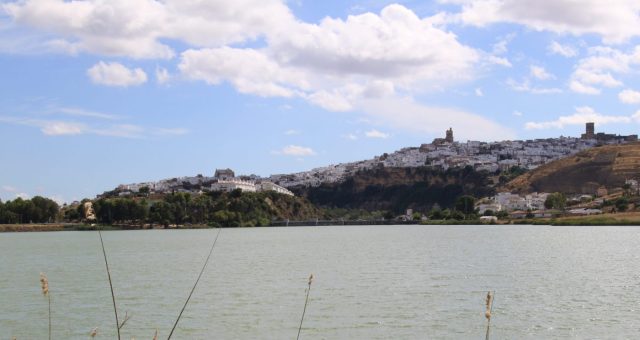
On top of a cliff, bathed in sunshine, lies a beautiful white Andalucían village. Here you won’t find many charter tourists. And if you’re in search for something authentic, Arcos de la Frontera is a good place to start.
Tourists travelling to the south of Spain are well aware of cities like Granada, Malaga, Cordoba and Seville. With their mix of urban and historic charm, these wonderful cities tempt thousands of travellers every year, and rightly so. Yet it is Costa del Sol that attracts the most, and especially during the summer hordes of tourists flock to the many resorts located along the sunny coast of the Andalucían region. Visiting several of these places, you easily get the feeling that the most Spanish about these so-called idyllic holiday places is basically the sunshine – but luckily, sunny weather can be found all over the southern region.
However, if you’re looking for something rather more authentic, you should definitely explore the inner part of Andalucía along la Ruta de los Pueblos Blancos, the route of the White Villages. These charming jewels of lovely villages offer a fantastic and almost untouched Spanish culture.
On top of a cliff
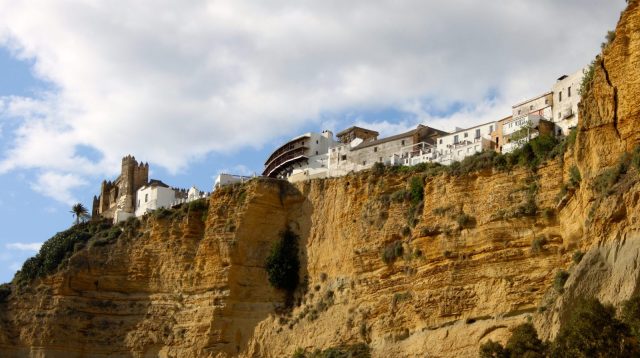
The largest village and without doubt the most dramatically sited, is Arcos de la Frontera. Arcos, known as the Queen of the White Villages, is balancing on top of a spectacular sheer cliff of limestone. Whitewashed houses and forts lie on the edge of the cliff that leads straight down to the fertile valley and the river Guadalete. As recognition for its exceptional architecture and impressive location, Arcos was declared a National Historic-Artistic Monument in 1962.
Arcos de la Frontera is divided between the newer part of town on the lower slopes of the hill, and the old town which you reach by following the street Cuesta de Belén up the hill. In this street you can see the Palacio del Conde de Águila, a 16th century ducal palace in Gothic-Mudéjar style with an elaborately carved stone facade.
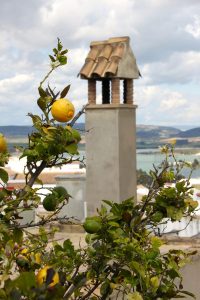
The picturesque Old town is a tangled labyrinth of cobbled streets leading up to Castillo de los Arcos. The castle was first built in the 11th century by the Moors when Arcos was a small kingdom, Taifa, before it was conquered by the Christians in the year 1250. The Christians rebuilt the castle as part of their battle to retain their grip on the city. The castle with its strategic position played an important role for the new rulers to maintain the boundary between the Muslim and Christian kingdoms. After the Christian conquest the castle became the home of the Duke of Arcos. Today it is privately owned and unfortunately not open to the public.
Cities or towns with “de la Frontera” in their names were established at strategic points along the frontline of the Christians battle to recapture Spain from the Moors. A battle that went on for several centuries, and the Moors were eventually driven back to Africa. Today these towns are no longer strategically significant and of course, no longer on high alert. They just lie there peacefully, minding their own business, as time is slowly moving forward.
Walking in a beautiful labyrinth

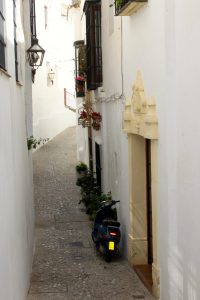
Towers, churches, narrow streets full of small reminders of its Arab heritage and magnificent viewpoints including views of the river Guadalete, are just some beautiful elements of what the village has to offer. The absolute best way to experience and explore Arcos is to wander around the streets of the old town. Some of the streets here are so narrow that cars can barely sneak around the house corners with only a few centimeters clearance to the whitewashed walls. Elsewhere you’ll hardly get forward on a scooter. And don’t be surprised if you actually have to move your table while you’re enjoying a coffee outside one of the coffee shops, to let a car pass through. But don’t worry, the traffic here is quite light, so it won’t happen very often.
Among the most memorable of Arcos’ beautiful streets are Calle Cuna and Calle Maldonaldo with their elegant palacios built by the city’s nobility in the 1700s. Part of the charm is that the streets in the old town are also the local children’s playground, so here you can find children playing football in the church’s patio. Feel free to join in.
Plaza de Cabildo – the heart of Arcos
Arcos is a wonderful adventure for people who love to take photos. Here you’ll find numerous of amazing picture objects. You can basically jump from one to the next throughout the city.
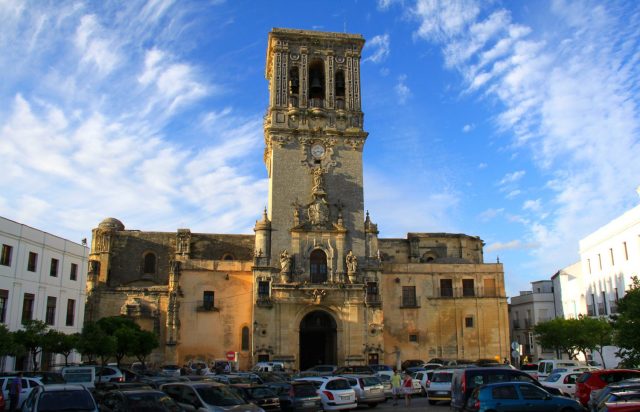
In the heart of the old town is the square Plaza del Cabildo. Its charming surroundings are somewhat marred by its dual function as a car park. The square is dominated by the magnificent La Iglesia de Santa María de la Asunción. On top of the church’s southern facade, you can see the beautiful decorated bell tower in Baroque style from the 1700s. Another highlight is the nicely carved doors to the west.
The town hall has remained in Plaza del Cabildo since 1634. The tourist office is also located here. Of particular interest is the doorway in stone crowned with the Archangel San Miguel, the patron saint of the village. Inside the town hall you can see a portrait of King Carlos the third attributed to the Spanish painter Francisco de Goya.
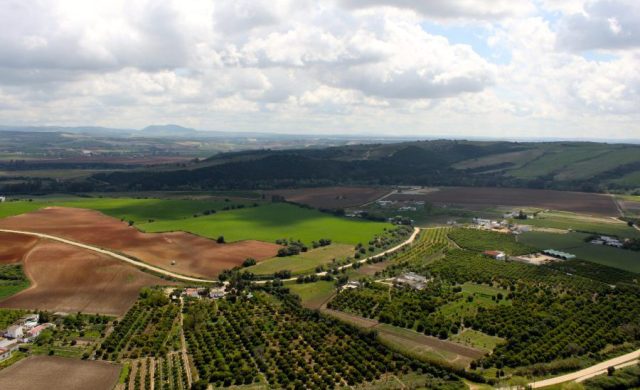
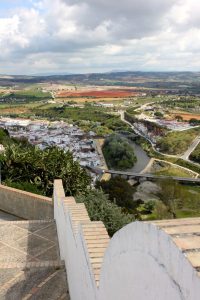
On the southern and open side of Plaza del Cabildo you’ll find the magnificent viewpoint Mirador de la Peña Nueva. Here you’re practically on the edge of a 150 meter high cliff with stunning views of the rolling countryside to the west.
Religious sights

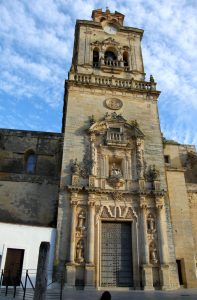
If you follow the streets next to the elegant hotel Parador, you’ll come to another impressive church from the 1500s. La Iglesia de San Pedro, the Church of San Pedro, has a dramatic location, and inside there is a gilded altarpiece in tribute to the life of San Pedro, and several paintings attributed to Francisco de Zurbarán.
It is easy to overlook all the tiny details in the old town. However, if you look closely on the short walk from the Church of Santa María to the Church of San Pedro, you’ll be able to discover exciting elements of the town’s past.

Near Paseo de Andalucía lies Hospital de San Juan de Dios. On the inside of this former hospital from the 1500s, you can find a church in Baroque style with an unusual altarpiece in pine. The church also has an impressive Gothic figure of Christ.
In Arcos it’s also possible to visit a convent. Convento de la Caridad was built in the late 1700s. The whitewashed convent in Colonial style at Plaza de la Caridad has great decorated interiors and is flanked by several attractive courtyards.
Food traditions and Running of the Bulls
Arcos is also a place where traditions are faithfully preserved, as can be seen especially during the different festivals in the village, or through its cuisine, where the Iberian pig and its own agricultural products play a key role.
Most tapas bars in the old town are concentrated on or near the central street Callejón de las Monjas. One to mention is Meson El Patio, an atmospheric cave-like bar near the Church of Santa María serving affordable tapas. If you are looking for something more formal, you can visit El Convento at Marques de Torresoto. The restaurant is one of the most exclusive in the village, located in a palace from the 1600s. The terrace in the luxurious Parador at Plaza del Cabildo is the place to go for a quiet drink in style. From here you can also enjoy the best view in Arcos.
Experience the unique annually festivals, and feel free to stop by the town’s traditional market located in an unfinished church, where construction was started by the Jesuits in the 1700s before they were expelled from Spain.
In early August you can join the festival Fiesta de la Virgen de las Nieves, with flamenco and other live music in the square Plaza del Cabildo, and on September 28 the three-day festival Feria de San Miguel starts, which is dedicated to the patron saint of Arcos.
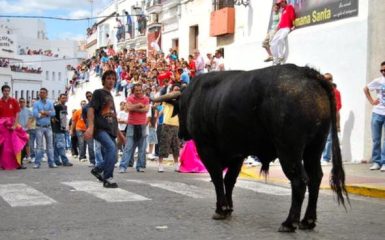
During Semana Santa, the Holy Week, Arcos de la Frontera suddenly springs to life. It’s during these celebrations, specifically on Easter Sunday, that a bull run, Toro del Aleluya, is held. Two bulls are unleashed and storm through the streets of the old town in true Pamplona style. It seems almost incomprehensible that they arrange a bull run here, because there are simply not many places to escape. If you’re still up for it, this is the place where you really get to put your manhood to the test.
 beachcastle