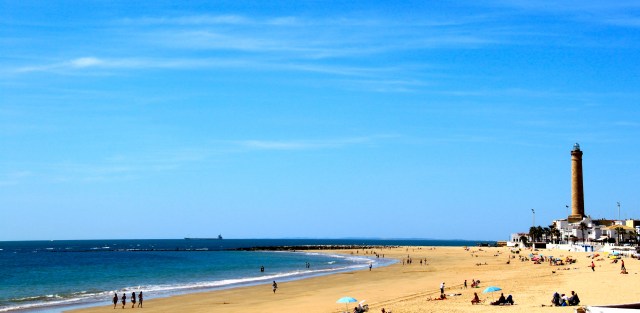
When to describe this lovely town, there are particularly four elements that stand out and which to me symbolize Chipiona; the characteristic church by the sea, the tall lighthouse, the wonderful beaches and, not least, the friendly atmosphere.
I’m standing on the seafront promenade, gazing at the sea. The sun is glistening in the water. It is the beginning of May. It is quiet.
In front of me lies the popular beach Playa de la Regla. To the left the church Santuario de Nuestra Señora de Regla dominates and to the right, at the other end of the promenade, the tower of the lighthouse rises. A well-dressed elderly gentleman with a hat passes me and greets buenas días with a smile.
Long wide beaches
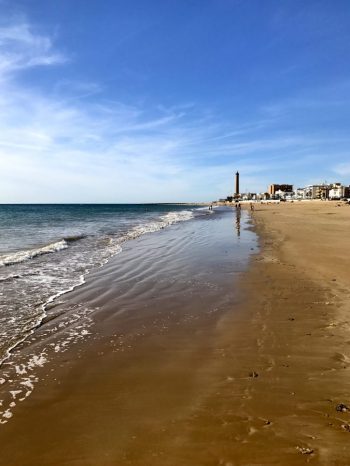
Chipiona is located in the northwest coast of the Province of Cádiz, next to the mouth of the river Guadalquivir. It is one of the most popular summer holiday towns along Costa de la Luz, much thanks to its wonderful beaches and excellent weather conditions. The climate stands out with soft winters and warm summers with an average annual temperature of 19ºC. Here, the streets are perfumed with a marine scent created by the fusion between sea and air.
The most famous beaches are Playa de la Regla and Playa del Camarón to the east of Chipiona, and Playa de la Cruz del Mar between the castle and the port. The coast by the town stretches over 11 km and includes many superb beaches of fine white sand, some awarded with Blue flag by the European Union for their high standards of facilities and cleanliness.
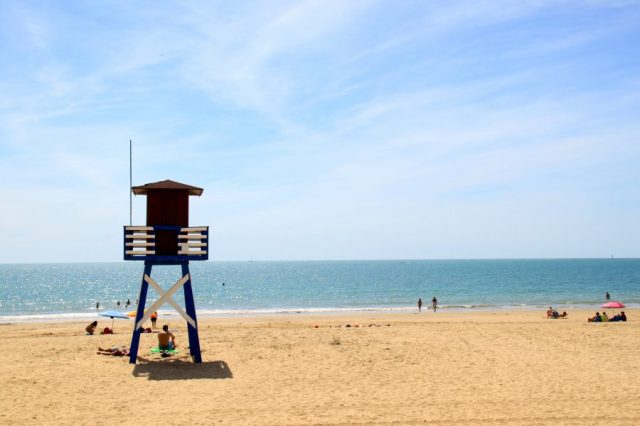
Today, there are not many people at Playa de la Regla, mostly locals relaxing in the warm, sunny weather. This, however, quickly changes once the high season is here. Especially during July and August, the beach transforms into a sea of parasols with lots of happy people who take full advantage of their days off. Nevertheless, the town manages to preserve the peaceful and friendly atmosphere even when it is at its most crowded.
Location, location, location
Chipiona has long been a popular destination, especially for Spanish tourists, and here you’ll find numerous hotels with their own particular styles.

However, if you are going for the best location, I can’t think of any better than Hotel Apartamentos Marina Luz, just a 10-minute walk from the centre of Chipiona. Located next to Santuario de Nuestra Señora de la Regla and the Regla Beach almost at the doorstep, only separated by the seafront promenade, the hotel has an exceptional location.
I’m greeted by Pepi, the hotel manager. In perfect English, which feels like a big relief after struggling with my limited Spanish for a while, she kindly shares her recommendations and knowledge about Chipiona and its surroundings.
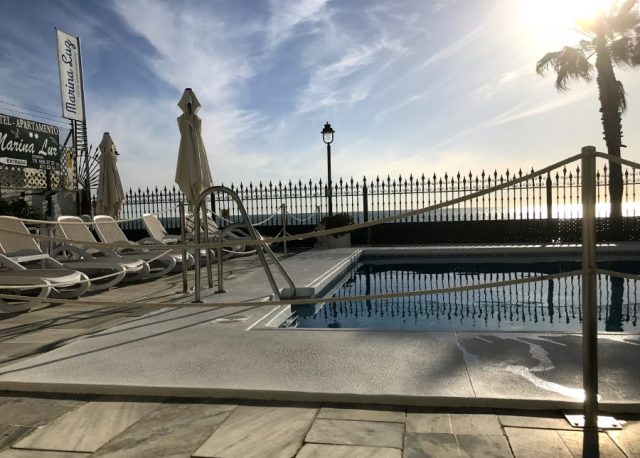
The hotel has a small, but lovely pool area, with stunning views of the beach and the sea. My favorite spot at the hotel, in addition to the pool area, is the rooftop terrace. Here you can enjoy a pleasant breakfast, or simply slow down with a cup of coffee or tea.

The hotel is spotlessly clean and has light public areas and comfortable rooms. I would recommend the studio apartments with sea view on the 1st or 2nd floor. These rooms have the best views. However, what strikes me the most about this place is the really helpful, friendly and service minded staff.
After a sunny, but slightly windy day at the beach I decide to head back to the rooftop. I meet Curro in the bar, and he serves me one of the best drinks ever. So refreshing (!) while I enjoy the afternoon sun on one of the many sun loungers. Perfect for an after beach.
Historical monuments and sightseeing along the beach
Today, Chipiona is first and foremost about the wonderful beaches and the soothing sea, but the site also has some important monuments worth exploring further. And being a seafaring town, the monuments are mostly found close to the beaches. Since I’m staying at Marina Luz, the church by the beach is a natural place to start.
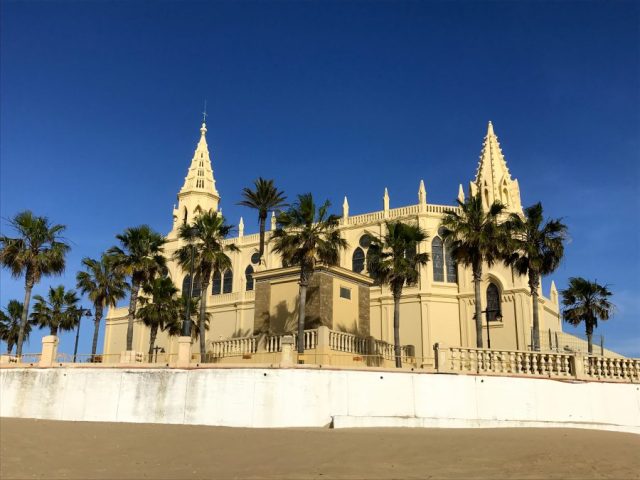
Santuario de Nuestra Señora de Regla (The Sanctuary of Our Lady of Regla)
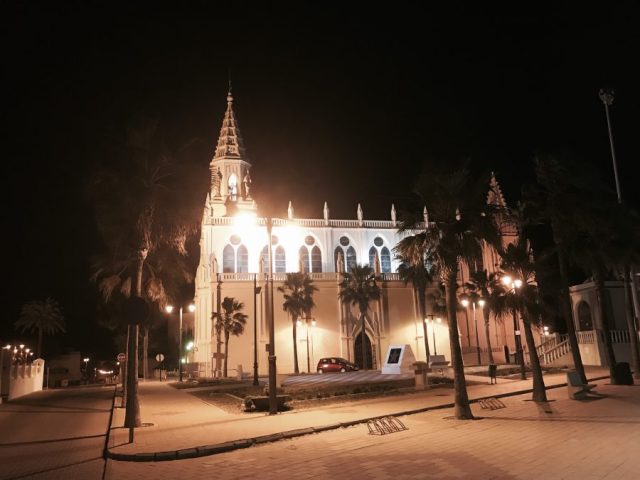
 Originally the Sanctuary was a castle fortress, and property of the Ponce de León family, Lords of Chipiona. It was donated to the hermits of San Agustin in 1399. The Augustine religious order transformed it into a Church; a place for worshipping the Virgin.
The hermits were forced to leave the Sanctuary in 1835, due to the decrees that resulted in the expropriation and privatization of monastic properties in Spain. These confiscations led to the loss of documents, ornaments, bells, marble floors and other valuables. However, the icon of the Virgin of Regla was taken to the local Parish Church where it remained for 17 years. The icon was returned by the Aristocratic Orleans family (Infantes de Orleans) to its original place on September 7th, 1852.
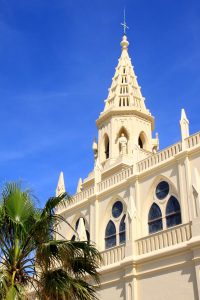 In 1882, the Government handed the Sanctuary to the Franciscan Father Lerchundi, allowing him to establish a missionary school for Morocco and the Holy Land.
On May 17th, 1904, the demolition of the old temple was approved and the construction of the new one was started thanks to donations made by the surrounding cities and towns. The building was completed in two years and was inaugurated on January 14th, 1906, and the construction of the bell tower was finished in 1909.
Today, the same Franciscan community inhabits the Monastery and attends to the Sanctuary.

El Humilladero (The Shrine)
Next to the church lies El Humilladero. According to the old tradition, this chapel was built on top of the well where the icon of the Virgin of Regla was hidden by a few monks during the Muslim occupation.
Legend has it that after La Reconquista (the reconquest), a monk discovered the icon next to the Sanctuary. During a dream he had a sight of where the icon was hidden. To remember the event a cross was raised. In 1963 the cross was eventually replaced by an outdoor chapel, by Father Nuño with the funding of the Duke of Medina Sidonia.
Rocío Jurado – the Voice of Chipiona
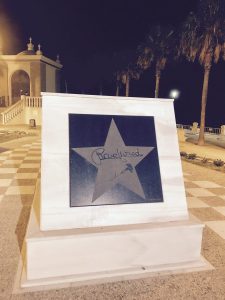
In the square outside the church, I notice a monument with a star in the style of Hollywood. This monument is a tribute to a huge voice and a former popular face on the big screen.
Rocío Jurado, daughter of Fernando and Rosario, was born in Chipiona on September 18th, 1946, and the oldest of three children. She studied at Colegio La Divina Pastora, where she was part of a choir and where she sang her first piece; Nos conocimos de niños. At the age of 15 she obtained her first award; the Flamenco Singing National Award in Jerez de la Frontera.
In 1960, with eight thousand pesetas lent by her grandfather, she travelled to Madrid, where she was introduced to the teacher Manolo Carocol and later presented to Pastora Imperio (la Niña de los peines), who hired her for her tablao (flamenco stage).
 In Madrid she also started her career as an actress, making her film debut in 1963 with the film Guerrilleros, featuring Manolo Escobar. Rocío Jurado had a life full of success, and was nicknamed La Más Grande (The Greatest). In 2000 in New York, she won the award La voz del Milenio for best female voice of the 20th century. Rocío Jurado sold more than 25 million records, and she received 150 gold discs and 63 platinum discs.
Sadly, on June 1st, 2006, she died from cancer at the age of 59. After her death she was transferred to Chipiona, where more than 20 000 people arrived to accompany her in the last goodbye.
Faro de Chipiona (The Lighthouse)
I follow the promenade along the beach in the direction of the lighthouse. The tall tower really stands out, and it almost feels like I’m being drawn towards it.
On the way I pass Monumento de la Luz (Monument of the Light) by the Argentine sculptor Luis Arata (1925-2009). The 8 metres tall modernist monument is made by iron sheets, fitted together to form a tower.
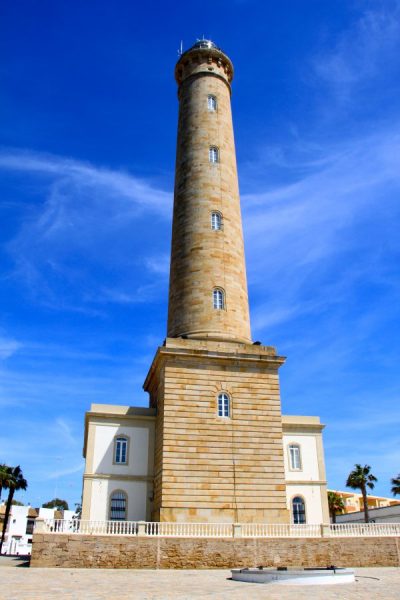
The Lighthouse, built between 1863 and 1867 by the civil engineer Jaime Font, is situated at Punta del Perro (Dog’s Edge). It is the oldest and most notable monument in Chipiona, and has become a true symbol of the town, together with the Sanctuary of Nuestra Señora de Regla.
The lighthouse was built to warn ships away from the danger caused by the large rock, Piedra de Salmedina. Despite the presence of the lighthouse, Salmedina has been responsible for many shipwrecks over the years.
With its 69 metres the lighthouse is the tallest in Spain, the third tallest in Europe and the fifth in the world. Inside you’ll find three apartments for the lighthouse keepers, surrounding a patio with an underground cistern. The tower, inspired by Roman commemorative columns, is hollow and has a spiral stairway on the inside. And taking the 322 steps is really worth it when you reach the top. From here you get a magnificent view of the town and its surrounding area.
On November 28th, 1867, the lamp on top, filled with olive oil, was lit for the very first time. It had a timing system with white flashes every 60 seconds. Later, the olive oil was first replaced by mineral oil and then by refined oil. In 1916 the lamp was operated by petrol steam pressure, which gave it a higher turning speed and one flash every 15 seconds. In 1942 it was changed to electrical illumination, with a 3000w lamp and three light beams with flashes every 15 seconds.
Since December 1999 it has been working with halogen light, and today the light reaches up to 25 nautical miles, with flashes every 10 seconds.
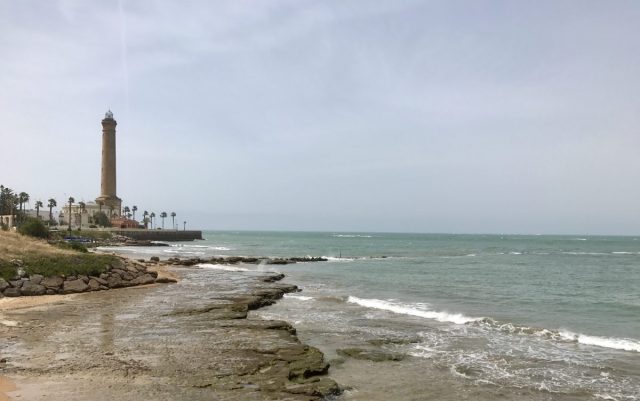
Castillo de Chipiona (The Castle of Chipiona)
Continuing beyond the lighthouse I pass three of the nine fishing corrals along the coast of Chipiona, before reaching Castillo de Chipiona. Fishing corrals are artificial traps built with “Oyster Stone” walls. Over time, a conglomeration of crustaceans forms a solid material, transforming the stones into a wall with a width of one and a half metres and the height increases from half a metre at the shore to two metres in the depths. The origin of this old fishing construction is unverified, but it is believed to belong to the Punic, Roman or Islamic period. Because of numerous repairs over centuries, it is hard to pinpoint the exact period.

The origin of Castillo de Chipiona is unknown. It has been attributed Alonso Pérez de Guzmán, “El Bueno”, but recent studies suggest that it was built in the 15th century.
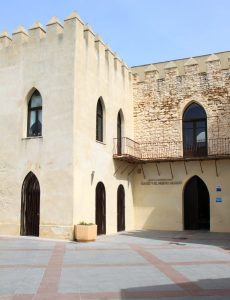
Throughout history, the castle has had different uses. According to public archives, it has functioned as a chapterhouse of the Town Hall, the dwelling of the parish priest, a local prison in the beginning of the 18th century and as the headquarters of the Civil Guard at the end of the 19th century. During the 19th and the 20th century it was a hotel, which included a five years stay of His Majesty Carlos de Borbón and Luisa de Orleans. María de las Mercedes, the mother of King Juan Carlos I, also lived in the castle according to her own memoirs.
Today, it’s possible to visit the exhibition “Cádiz and the New World”, dedicated to the relationship of the province of Cádiz with the discovery and colonization of América. Next to the main entrance you’ll also find the tourist office.
Plaza de Juan Carlos I
A short walk from the castle, following Calle Dr. Tolosa Latour, takes me to the pretty Plaza de Juan Carlos I (Juan Carlos I Square). Here I find the Parroquia de Nuestra Señora de la O, Ermita del Cristo de las Misericordias and a nice building belonging to the Ayuntamiento (Town Hall).
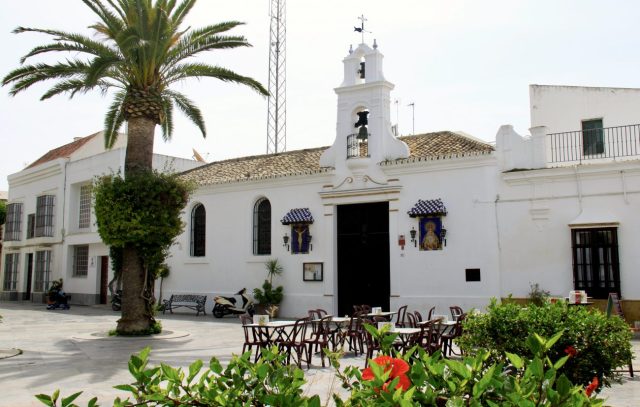
Ermita del Cristo de las Misericordias (Chapel Christ of Mercy)
This chapel is dedicated to the icon of the Christ of Mercy. The icon has many devotees in the town as a result of the Lisbon earthquake, which took place on November 1st, 1755, and caused a tsunami that reached Chipiona. A procession to La Cruz del Mar was organized by the brotherhood and the people of town. Equipped with the icon they prayed for the water to retreat back to the sea, and miraculously the water withdrew.
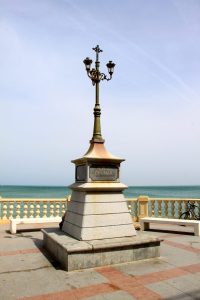
From that date, an annual procession with the icon of the Christ of Mercy has been organized, following the same route from the chapel in Juan Carlos I Square to Monumento de la Cruz del Mar. The monument is at a viewpoint located on the seafront promenade at the end of Calle Isaac Peral. Its history is detailed in a plaque next to the stairs that lead to the beach, Playa Cruz del Mar, which is named after the monument.
On November 1st, 1755, which date recalls the formidable Lisbon Earthquake, this town was invaded by the sea. Overcome by panic, its population took the Cristo de las Misericordias out in a procession, which was brought to this place. With its presence the waters withdrew. To commemorate the memory of the protection of the town, a monument was raised at this place which was rebuilt in 1878 and restored in 1910.
Monumento de la Cruz del Mar
Parroquia de Nuestra Señora de la O (Parish of Our Lady of O)
The church has been thoroughly altered since it was first built in 1579. However, the North door has been kept from the original Gothic building.
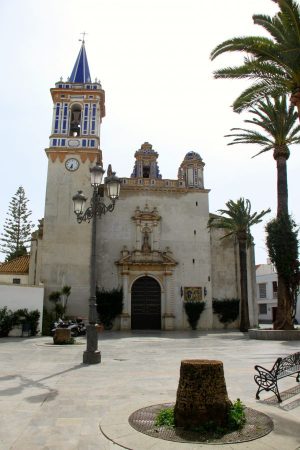
The destructions after the tsunami, caused by the earthquake in Lisbon, in 1755 resulted in the transformation of the temple, and a new West door was built. Outside a tower was raised, finished with a dome and decorated with tiles.
The construction of the current church started in 1792. The actual structure comes from the 18th century repairs. It is the descendant of the first gothic church, but the new construction followed a more classical style. The high chapel is the same one that existed in the original church. The new church was blessed on January 14th, 1797, by the priest Pedro Sánchez Guerrero.
When visiting Parroquia de Nuestra Señora de la O, especially two sculptures stand out. The first one is located at the main door: a beautiful and simple sculpture of the Virgen de las Rosas. This is actually a reproduction, and you’ll find the original one (from the 16th century) inside the church. The other one, Virgen de la O (from the 18th century), is a polychromatic wooden icon, which represents the fertility of Virgin Mary. It is at the head of the temple, the high altar, and is housed in a neoclassical canopy that is in front of the original altarpiece.
In 1914 and 1917 some restorations were made to the church, and the last restorations of the roofs, the main façade and the tower took place in 1979.
Historical centre and great tradition

 The commercial sector is mainly concentrated in the historical centre of Chipiona. To experience the essence of trade in Chipiona, I decide to take a stroll through the main streets Miguel de Cervantes and Isaac Peral, which is highly recommended. Here I really get the feeling of personalized service and friendliness towards the customers. It’s a unique shopping area with a mix of traditional family establishments, which have managed to keep the peculiarity and essence of the past alive, and stores with modern facilities that offer new and exclusive products.
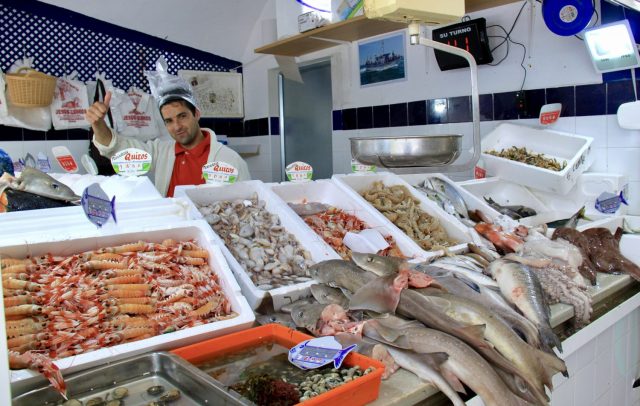
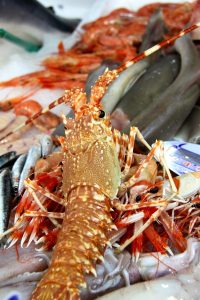 El Mercado Municipal de Abastos, located in Calle Isaac Peral, is a historical place of great tradition. Daily, locals and visitors flock to the market to purchase products of high quality, mainly fresh fish and seafood directly from the sea. Here you’ll also find a huge variety of meats, vegetables, and fruits.
Walking between the different stalls in the market is like its own little journey. To visit the busy market is best in the morning, and it is normally open from 08.00 to 14.00.
Where to eat?
Chipiona has an exquisite gastronomy, offering a variety of seafood, vegetables, fruits and muscatel wine, and the town centre has plenty restaurants and bars to choose from. Since I’m staying at Marina Luz I decide to find places closer to the hotel. Following Paseo Costa de la Luz I reach Avenida de Jerez. Here there are immediately two very good options. And it’s so close to the beach.

Tasty tapas at La Concha
 I’m welcomed by Dani, and with a big smile he recommends the tapas menu. The menu is quite impressive, and here you’ll get quality food at a good price. This way I also get to try a variety of their dishes.
It is a bit louder than I’m used to, but I like the informal atmosphere and especially the waiters’ sense of humour. The rather charming Dani tells me that the place can get really packed, especially during high season, and it can be difficult to get a table at certain times.
It’s an ideal place for a tapas lunch or dinner. Just keep in mind that the tapas plates here are quite big. If you have the chance, try the mini-burgers. They’re just lovely!
Lunch at La Laura
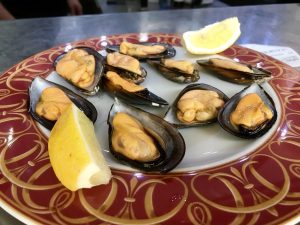 La Laura seems to be very popular among the locals, and to me, that is always a good sign. Like La Concha, it is a busy place, and you have to expect to wait a bit to get a table during the summer months.
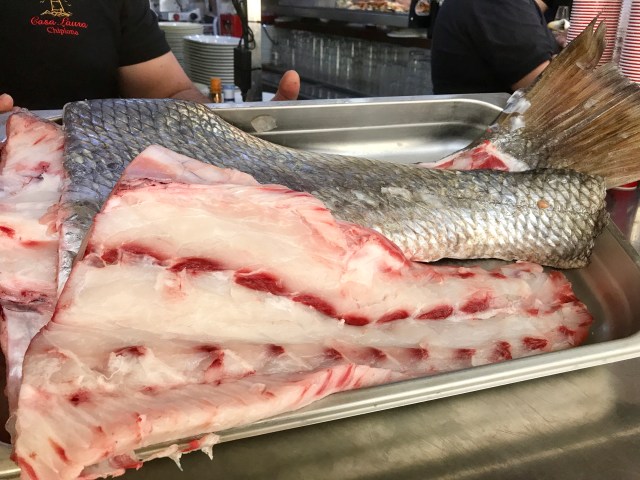
The restaurant is known for its fast and attentive service and offers a varied menu. All at reasonable prices. Their main focus is on seafood, and Juan Manuel, the owner, proudly shows me several plates with seafood ready for service.
Dinner at El Faro
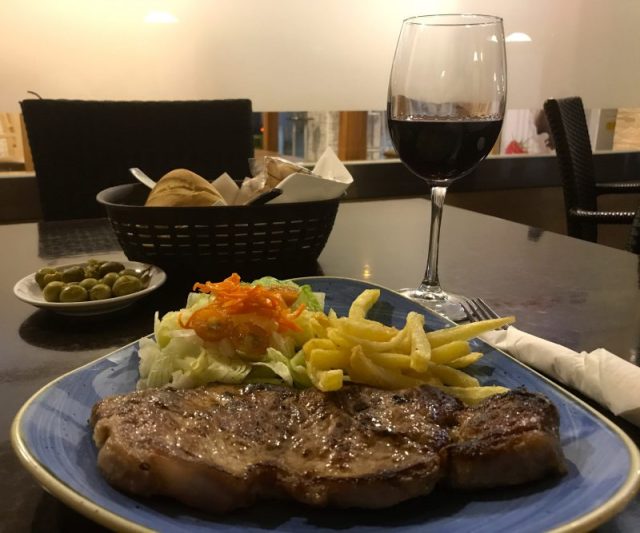
By the recommendation of Pepi, I decide to have a late dinner at El Faro, a restaurant on Avenida de Sevilla, naturally not far from the lighthouse. I’m greeted by Conchi, a very nice lady from Chipiona who works as a waitress. It’s a warm evening, so I prefer to sit outside. I order entrecôte with salad and fries and a glass of Rioja red wine. And I have to say, you’ll have to look hard to find a juicier and more tender entrecôte, certainly some of the better I’ve ever tasted. And on top of it all, Conchi comes to the table with extra fries, as the last ones are about to disappear from my plate.
At the bar, Luis, the bartender, offers me a small bon-bon (ice-chocolate) and limonchelo. What really strikes me is that the people here are so friendly and it seems so genuine. Brilliant food and brilliant service. I’m definitely coming back.
As I’m about to leave, the owner Daniel, el jefe, offers me rum and coke (size grande, which apparently is quite typical around here). After the drink I say muchas gracias for the exceptional service and wander out into the dark night.
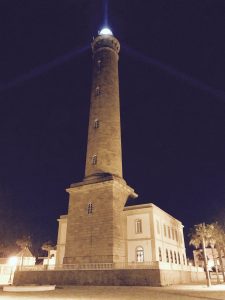 I decide to go down to the lighthouse and I simply love how the building is lit. It is also quite powerful to see the three beams of light from the top of the tower. It has been a long day, and for me, it’s time to head back to the hotel. I take the seafront promenade, and on my way I pass a few bars and an Irish pub. There are not many people out tonight, but those who are here seem to enjoy themselves. As I walk along the promenade under the streetlights, I hear the sound of gentle waves. This fills me with an inner calm and I really wish I could stay longer. At the other end of the promenade, I see the majestic church great lit, almost as it’s leading the way home. It all fits perfectly to the town’s nickname – Ciudad de la Luz.
Want to see more? Check out these links:
 beachcastle