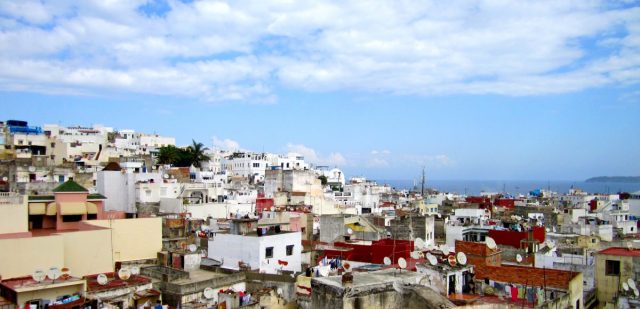
Tangier is located on the northwest shore of Morocco, and to many it’s the natural gateway to Africa. Although the city is just a short boat trip from Europe, it’s like stepping into another world. A world of an ancient time, which offers encounters with street vendors, camels and snake charmers with their legendary cobras.
It’s a warm Sunday morning. We are heading into the passenger ferry that will take us from Tarifa in southern Spain and across the strait to the port of Tangier, entirely northwest of Morocco. On a clear day it is actually possible to see the African continent from the southern tip of the Spanish mainland.
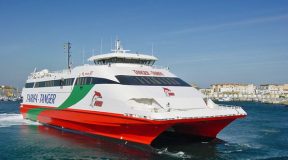
The boats that hold a high standard are going from nine o’clock in the morning until around half past nine in the evening local time. The journey by the fast ferry is estimated to take only 35 minutes, but because of some delays due to the passengers getting on and off, it takes us almost one hour in total. This however, appears to be completely normal. A tip is to have your passport and papers in order and ready as you board the ferry.
Meeting with a local guide
Arriving on the other side of the strait that separates the two continents, we are met by a pack of hungry “guides”, who are ready to jump at every little confused tourist at the dock. They gather around us, offering guided tours of Tangier. It’s all quite intense. For many of these men the tourists represents the only opportunity to earn a few daily coins. The trick here is to stay calm and polite but also firm. And it doesn’t hurt if you pretend to know the place. Smile and move on.
One of the local guides, Ibrahim, is more eager than the others. While our small group is approaching the exit of the harbour area, the little persistent man in the late 40s is still hanging on. He does not take no for an answer, and insists on showing us his city. We finally agree that he can take us to the snake charmers, but from thereon we want to manage by our own.
Ibrahim is a bit pushy, but yet charming and friendly. Our sudden friendship is when all is said and done, a case of business. This is after all his livelihood, and he does everything he can to support his family. Still he seems to show a great pride in taking us into his hometown, where he leads us to the old town not far from the harbour.
Medina – a medieval maze
Tangier’s Medina, the old town, slopes down to the sea in a maze of alleyways and narrow medieval streets. Here we find the square known as the Petit Socco, where old men sit most days drinking tea and playing backgammon. In the ’60s some parts of the Medina were habitat and playground for many famous writers and artists.
We follow the self-appointed guide up in the myriad of narrow alleyways that meander in all directions. Here it is not unusual to get lost, even for those who have been here before. Meanwhile, it’s part of the experience, and there is no reason to panic. Following a road downwards takes you back to the harbour area, and a walk out to the edges makes it easier to orient oneself.
Ibrahim wants to show us the Medina’s true face and takes us into a carpet shop, where we are allowed to climb onto the roof. From this point we get a priceless overview of the old town, and it really feels like we’re back in time. As we climb back down again, it comes as no big surprise that the storeowners want to show us the diversity of different carpets they have to offer. All in the hope of selling a carpet or two. That’s just how it works. The local guides leading tourists to certain stores that are run by friends or family, and if it ends with a purchase the guide gets a small commission.
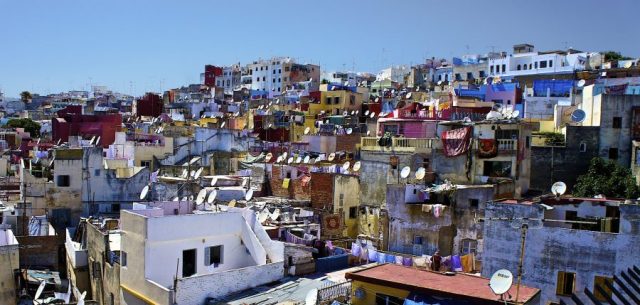
On our way up to the market square where we hope to see some snake charmers, Ibrahim suddenly points at a yellowish limestone coloured house with a maroon port. – That is my childhood home, he says with a smile and tells us that he used to play and run around in these streets as a young boy.
Cobra in Kasbah
The Kasbah, the fortress where the sultan once lived, dominates the Medina’s northern part. Within the main gate we find a large courtyard that leads to the Dar el-Makhzem Palace and the more recent Kasbah Museum of Moroccan art. The palace was built in the 1600s, and for each reigning sultan, the palace was expanded. With its ceiling in carved wood and its courtyard made of marble, the palace is a pure showcase of Moroccan craftsmanship.
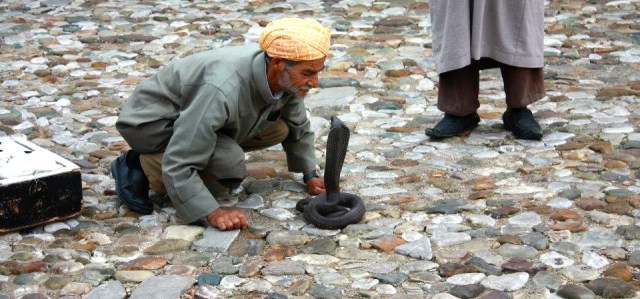
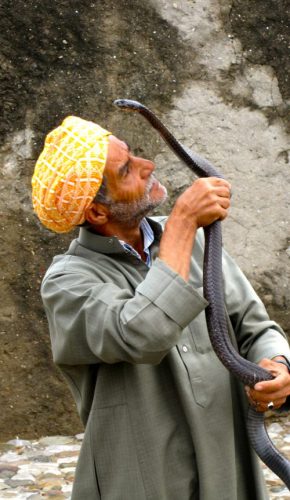
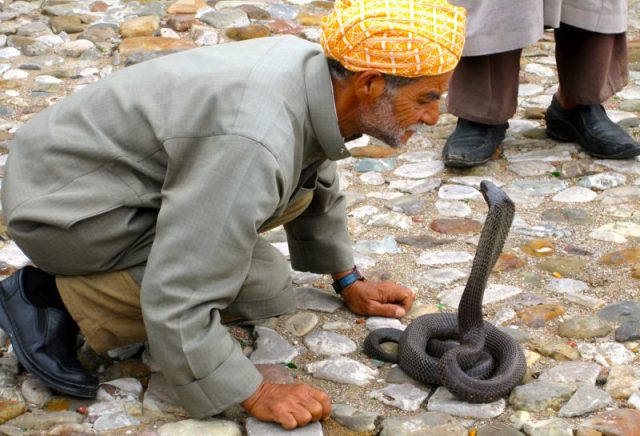
It turns out to be a pretty quiet day in the Medina, but we are lucky and find a snake charmer in the middle of the market square. Out of a woven basket the little tanned man takes out a massive cobra. To the rhythms of simple drums he shows us his skills. With wide-open eyes, we watch how he bends down and puts his forehead on top of the cobra’s head. We also get the opportunity to have a slightly smaller snake around our necks. Perfect for pictures. We thank the brave man and hand him some Euros for the spectacular demonstration.
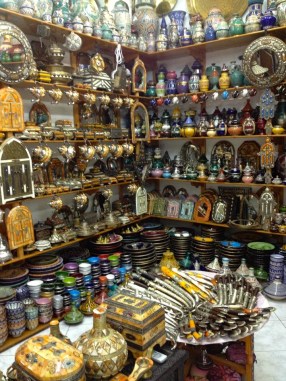
Having said goodbye to Ibrahim, we continue to explore more of Tangier’s charming and mysterious Old Town. The narrow streets, which at times are very lively, are filled with shops, cafés, teahouses and small restaurants. Here we find carpet shops, souvenir shops with handmade jewelry, wooden boxes and hookahs (water pipes), and typical Moroccan clothing stores with everything from colourful fabrics to the distinctive red hat, fess or fez. The fez is named after the town of Fes in Morocco, because the red colour had originally been extracted from red berries that were growing there. Today people wear the fez as part of folk costumes in Morocco.
Roundtrip in a beige Mercedes
We stroll out of the Medina and come out on the square Grand Socco. Along one side are some old, tired taxis. The beige Mercedes are very simple, and all that indicates that they are actually taxis is a small white sign on the roof and a red badge on each of the front doors. Here there are no shiny advertising signs screaming at us.
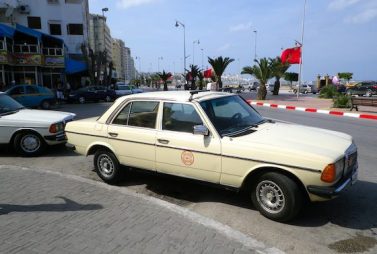
The drivers light up discreetly as we approach them. We greet them and after a short and friendly negotiation we agree on the price. For 20 Euros they are willing to take us to see some camels and a famous cave we’ve heard about.
Our small entourage of nine jumps into two taxis, and the fact that one actually has one passenger too many does not seem to bother the driver that much. The safety of these cars is not exactly a top priority, and seatbelt and airbags seem to be luxury.
Cape Spartel
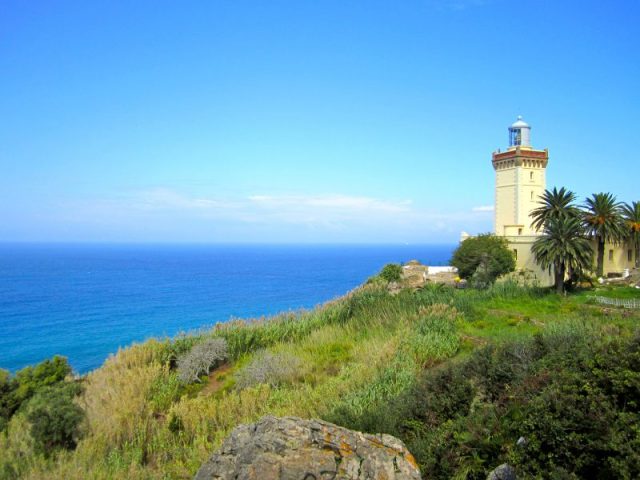
We drive west, and approximately 12 km from Tangier is Cape Spartel. The promontory is often but incorrectly referred to as the northernmost point in Africa. However, that is Ras ben Sakka in Tunisia, while Cape Spartel is Africa’s most northwestern point, and marks the entrance of the Strait of Gibraltar.
At the edge of the promontory, about 300 meters above sea level, there is a beautiful lighthouse and from here we get a magnificent, panoramic view of the site where the Mediterranean Sea meets the Atlantic Ocean.
Camel ride under the African sun
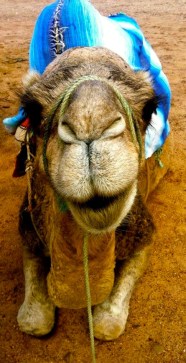
The taxi driver then heads south, and after a short drive the taxi stops on a plain along the road. We look questioningly at the driver. – Camels, he says smiling and pointing in the direction of a small group of men looking after four adults camels.
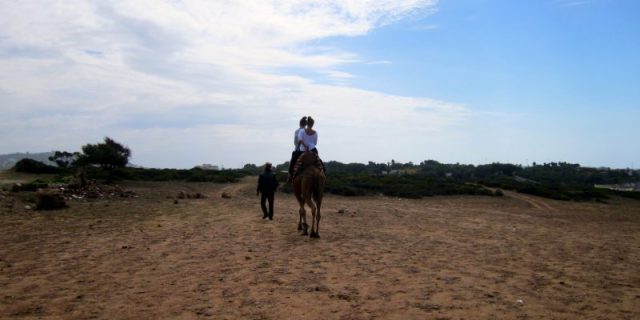
For a few Euros each we get to ride on the camels and take pictures with them. The whole thing is sort of a must. It’s not like we get such an opportunity every day, and after all we’re in North Africa. Two of the camels don’t look overly eager to take us on tour, but gradually rise from their drowsiness, and the four desert ships amble along with some slightly anxious tourists on their backs.
Les Grottes d’Hercule (The Caves of Hercules)
Two kilometers south of Cape Spartel we arrive at one of the tour’s main sights. The Caves of Hercules is one of the most popular tourist attractions near Tangier.
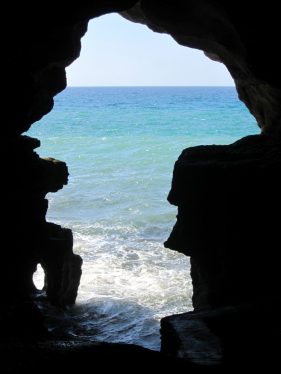
A local guide takes us through the only entrance from land and into the caves. There is also another entrance, but this is from the seaside and is known as “the map of Africa”.
– It’s believed that the Phoenicians created this opening in the shape of Africa seen from the sea, the guide tells us with great enthusiasm. Here we also find some markings on the walls in the shape of eyes. It’s claimed that these shapes also were made by the Phoenicians, and together they form a map of the local area.
The caves are partly natural and partly anthropogenic. The manmade part was used by the Berbers to cut stone from the walls to make millstones. This way, the caves were expanded considerably.
The resort town
On the way back to Tangier we drive through a finer area with several large and beautiful holiday houses. Everything in sharp contrast to the simple and worn houses we find in the Medina. Said, one of the drivers, explains that the king of Morocco tends to spend his vacations in Tangier.
We pass a well-guarded area. Here we see guards equipped with automatic weapons. – This is the summer palace of the King of Morocco, says Said when he sees our puzzled faces. The palace itself is almost impossible to see because of the surrounding high and solid walls.
We drive through parts of the newer and more modern part of town, Ville Nouvelle. Here the traffic is heavier and more hectic. To the sound of car horns on all sides, we pass several nice buildings with architecture from the 1800s and early 1900s. The tired cars get us safely back to square one. It’s been an eventful roundtrip with friendly drivers – worth every cent.
Grand Socco
The Grand Socco, the main square, marks the end of the new city and the entrance to the Medina. The square’s official name, which is rarely used, is Place du Grand 9 Avril 1947 that was given after the speech of Mohammed V in honour of Morocco’s independence of April 9, 1947. This is where locals come to stroll, play and sit for hours at the around-lying cafés and teahouses. In the square’s northern part, we find the gardens of Mendoubia with its lovely marble fountain and several benches – a shaded place full of figs and dragon trees.
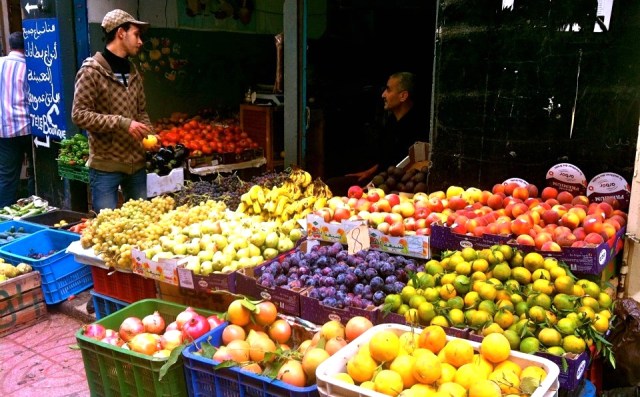
The square is particularly lively in the afternoon when the merchants set up their stalls. At the colourful market we are presented with a multitude of fruits, vegetables, spices and partly used goods. Here we get a chance to really demonstrate our bargain skills, and it is possible to make a really good deal if you are a tough negotiator.
The evening approaches, and it is time to head back to Europe. We make our way down to the dock to avoid missing the last boat back to Tarifa. This time, however, the boat is very late, and after nearly one hour of waiting, we board the ferry yawning.
It’s been an adventurous day, and even though Tangier of course has a lot more to offer, you can’t really ask for much more in just one single day. Remember, if you want to return – the Old World is only 35 minutes away.
 beachcastle
Fantastic pics. I have not been there but I’ll go for sure very soon . It’s on my years list. Lets see if I can make it happen
Thanks! If you get the chance you should also check out this place: https://beachcastle.wordpress.com/2016/02/18/tarifa-a-european-surf-paradise/
You could stay in Tarifa and visit Tangier for a day… A nice combination. Have a safe and adventurous trip!
Hey, believe or or not but I was in tarifa but did not make it.sadly I was to much involved in Kite surfing. I could have simply crossed continents on a board but was a bit scared. 😋